



According to the Kenya National Bureau of Statistics (KNBS), the country is the leading tea producer in Africa and the third largest in the world. Kenya is the leading exporter of black tea. In 2023, tea production in Kenya reached around 537 million kilograms. Production was down on previous years. Kenyan tea accounts for around 96% of total exports.
However, other tea varieties are also produced, albeit in smaller quantities. These include green tea, which accounts for around 2% of total production. Demand for this product on international markets is growing steadily. White tea is also produced in this East African country. Although produced in small quantities, this variety is considered a niche product. Another variety is Oolong tea. This is less common. A few plantations are reserved for this variety.
$1.2 billion generated by tea exports in 2023
Tea exports generated $1.2 billion(180.6 billion shillings) in 2023, up 31% on 2022 revenues of $941.4 million (138 billion shillings), according to Willy Mutai, Managing Director of the Tea Board (TBK), noting that this is a new record for the sector.
To boost Kenya’s economic growth, the country needs to address tea quality because Kenyan tea faces a fairly vigorous quality infrastructure to compete internationally and add value to this tea. The Kenyan authorities need to invest in giving tea a geographical indication label, which will make it more valuable on the international market,
Honoré Mondomobe, economic intelligence expert, quoted by the Kenyan Daily Board.This good performance by Kenya’s tea industry is due to favorable exchange rates, stable prices and increased export volumes. Total export volume has risen by 16%, from 450.33 million kilograms in 2022 to 522.92 million kilograms in 2023. In addition, Kenya increased its export destinations from 82 to 92. Pakistan remained the largest importer of Kenyan tea, with a 15% increase in imports.
Kenyan tea is very important for the economy, but there’s the whole quality infrastructure that needs to be strengthened. The whole tea production chain should be easily traceable by large consumers. So tea should also have a label that demonstrates a certain seriousness and certification by accredited laboratories,
adds Honoré Mondomobe.With an overall increase in tea production and a strategic focus on expanding export markets, Kenya is set for continued growth, according to the government’s outlook. The country has set itself the target of increasing the level of value-added tea exports from 5% in 2023 to 50% by 2027. In East Africa’s largest economy, tea is one of the main growth drivers, contributing 2% to GDP.
10% of the working population employed in the sector
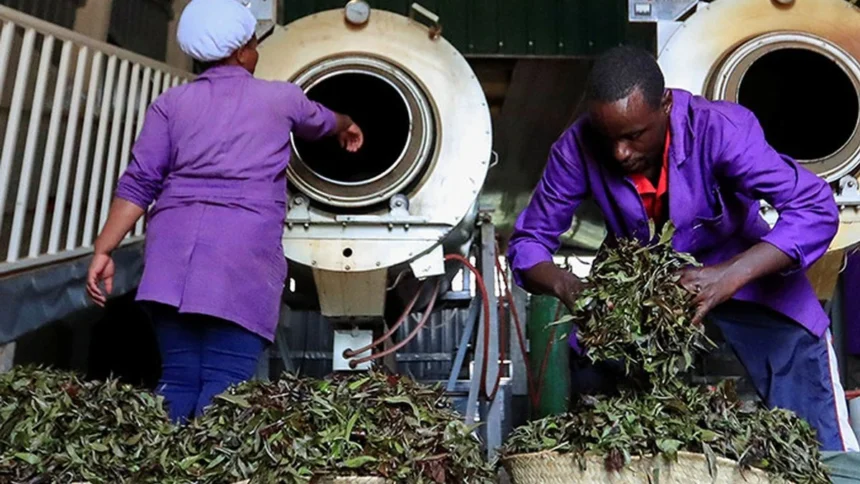
Tea production plays an essential role in the country’s economy, particularly for local communities in tea-growing regions such as the Rift Valley, the Highlands and other areas with favorable climates. The tea sector is one of Kenya’s largest employers, providing jobs for millions of people, particularly in rural areas. Around 600,000 smallholders grow tea on small plots of land, accounting for 60% of Kenya’s total tea production. The tea industry directly employs around 10% of Kenya’s working population, with over 3 million people depending on the sector for their livelihood, including farmers, plantation workers and processing plant employees.
The success of Kenyan tea on the international market
Kenyan tea is one of most important exports. According to the Kenya Tea Directorate in 2023, Pakistan imported around 38% of Kenya’s total tea exports. Pakistan imports around 150 million kilograms of tea a year. It is followed by Egypt, which accounts for around 20% of total Kenyan tea exports.
Each year, Egypt imports around 90 million kilograms of tea. Next comes the United Kingdom, with around 10% of total Kenyan tea exports, and imports of around 40 million kilograms of tea a year. The United Arab Emirates is another destination for Kenyan tea. This market accounts for 7% of total exports, and imports around 30 million kilograms of tea a year. Kenyan tea is also exported to Afghanistan and Sudan.
These two nations account for 6% of exports and around 25 million kilograms of tea a year. These countries are the main markets for Kenyan tea. These figures were published in the annual reports of the Kenya Tea Directorate, the official regulatory body for Kenya’s tea sector. They demonstrate the importance of the product on the world market.
A favorable climate for production
The country is the world’s third-largest tea producer, after China and India. On the African continent, it ranks first. The ideal climatic conditions and fertile soils of Kenya’s mountainous regions are conducive to tea production. Today, millions of small farmers and large plantations contribute to making tea one of the country’s main exports. Production is based on cultivation and processing methods that produce black, green and specialty teas, which are highly prized on international markets.
The Great Rift Valley, to the west of Kericho, is Kenya’s largest tea-growing region, with almost 10,000 hectares of highland plains under cultivation. Unilever, an Anglo-Dutch multinational established in 1924, owns 28 plantations and eight factories. Finlays Tea Extracts, the world market leader in tea extracts, has been present in Kenya since 1925, owning nine plantations and four factories. Another player in this sector is Williamson Tea. Established in Kenya in the 1950s, the production unit now owns four plantations, each with its own factory.
Small companies are also involved in tea production in Kenya, as are 11 factories belonging to the Kenya Tea Development Agency, which processes the harvests of the region’s small producers. The Central Region, Nyeri located on the slopes of Mount Kenya, is known for producing high quality tea thanks to its high altitude and fertile volcanic soil. Murang’a and Kiambu also produce significant quantities of tea, with climatic conditions similar to those in Nyeri. Also, the Western Region, Kakamega, less well known than Kericho, is an important production area, especially among smallholders, according to Tea Directorate of Kenya.
The benefits of high altitude
Most of Kenya’s tea plantations are located between 1,500 and 2,700 meters above sea level. This important position enables them to produce high quality tea. Cooler temperatures slow leaf growth, concentrating flavours. The tropical or subtropical climate with regular rainfall is also conducive to the cultivation of quality tea. Kenya’s main tea-growing regions receive between 1,200 and 1,400 mm of rain per year. The Kericho region, for example, receives rain almost all year round. Ideal for tea growing. The well-drained volcanic soils are particularly well-suited to this crop. They are rich in minerals. Essential ingredients for tea production. Finally, moderate temperatures (between 18°C and 30°C) are ideal for production. Mechanization is limited due to the hilly terrain and traditional practices.
However, some plantations have introduced picking machines, especially in regions where labor is scarce. Technological innovations such as the use of drones enable plantations to be monitored and the use of resources such as water and fertilizers to be optimized. The introduction of precision irrigation systems in regions has enabled better water management, especially in times of drought. Sustainable cultivation practices are also behind Kenya’s good performance in tea production. Agroforestry, reduced pesticide use and integrated pest management have all proved their worth in Kenyan tea production.